How Much Roof Space Do You Need for Solar Panels?
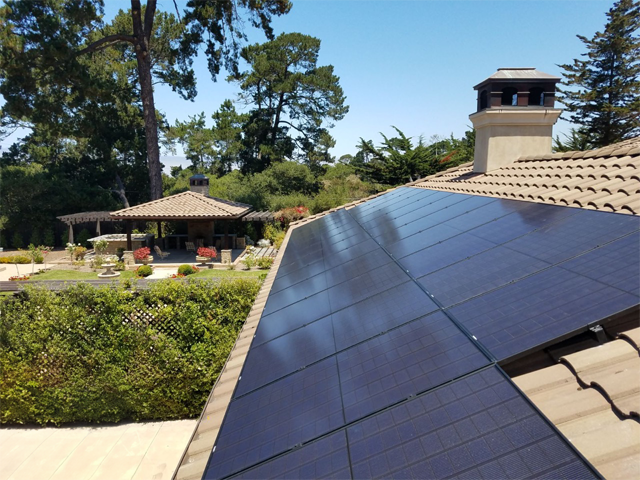
This image shows a roof covered in residential solar panels overlooking a cute suburban yard and garden.
Most residential solar panels take about 18 to 21 square feet each. REC’s Alpha Pure-R (the platform behind the all-black, high power-density look we like) is about 20.8 sq ft per panel and up to 430 W.
Roof space estimate (quick and dirty):
# of panels ≈ (your target system size in watts) ÷ (panel watts)
Panel area ≈ (# of panels) × (panel sq ft)
Real roof area needed ≈ (panel area) × 1.15 to 1.30 (setbacks, hips, valleys, vents, walk paths)
That last line is the one most people miss.
Step 1: Estimate the system size you need
If you want a back-of-napkin estimate, start with your electricity use.
The average U.S. household uses about 10,500 kWh per year.
From there, your required system size depends on your sun exposure and roof orientation. Many homes land in the 6 kW to 10 kW range, but your actual target should be based on your last 12 months of bills and a site assessment.
If you want the cleanest answer for your house, start here:
Step 2: Convert system size into panel count and roof area
Using REC Alpha Pure-R up to 430 W at ~20.8 sq ft per panel:
Example A: 6 kW system (6,000 W)
Panels: 6,000 ÷ 430 ≈ 14 panels
Panel area: 14 × 20.8 ≈ 291 sq ft
Real roof area with layout factors (15% to 30%): 335 to 378 sq ft
Example B: 8 kW system (8,000 W)
Panels: 8,000 ÷ 430 ≈ 19 panels
Panel area: 19 × 20.8 ≈ 395 sq ft
Real roof area: 454 to 514 sq ft
Example C: 10 kW system (10,000 W)
Panels: 10,000 ÷ 430 ≈ 24 panels
Panel area: 24 × 20.8 ≈ 499 sq ft
Real roof area: 574 to 649 sq ft
That is why power density matters. When roof space is limited, higher output per panel can be the difference between covering some of your usage or nearly all of it.
What changes the roof space you actually need
1) Roof geometry and obstructions
All of those funny shapes and protrusions on your roof can make things interesting. Hips, valleys, dormers, plumbing vents, skylights, chimneys, attic fans, and ridge vents all break up usable rectangles. Solar layouts love uninterrupted planes.
2) Setbacks and access paths
Most jurisdictions and fire codes require clearances around roof edges or ridges, plus service pathways. That reduces usable area even when the roof looks “big enough.”
3) Orientation and shading
A smaller unshaded south or west plane can outperform a larger plane that gets shade from trees, dormers, or neighboring structures.
4) Aesthetics and symmetry
For an Innovation-focused install, we treat the array like an architectural element. Sometimes the “maximum panel count” layout is not the best layout if it creates awkward edges, uneven rows, or visual clutter.
If you want a roofline that looks intentional and premium, the design process matters as much as the math.
Why we prioritize high-density, all-black panels for Innovation
REC’s Alpha Pure-R is designed for high power in a compact footprint and a full-black appearance, which helps you get more production without covering the roof in panels.
That combination supports the Innovation goal: modern infrastructure that looks clean, performs hard, and complements the home.
If your roof is not a perfect match
You still have options:
Higher density panels to hit targets with fewer modules
Partial offset systems sized to your best roof planes
Ground mount if you have space and want maximum production
Add-ons later if you plan EV charging or electrification
A good design aligns production goals, roof constraints, and aesthetics, not just panel count.
Frequently asked questions
-
A common range is ~450 to 650 sq ft of real roof area for an 8 to 10 kW system using high-output panels, depending on layout factors.
-
You may still be a great candidate. It often means sizing to offset a portion of your bill, or using higher power density panels to maximize the best roof planes.
-
South is strong, but west can also perform well depending on your utility rates and your home’s usage patterns. The right answer is site-specific.
